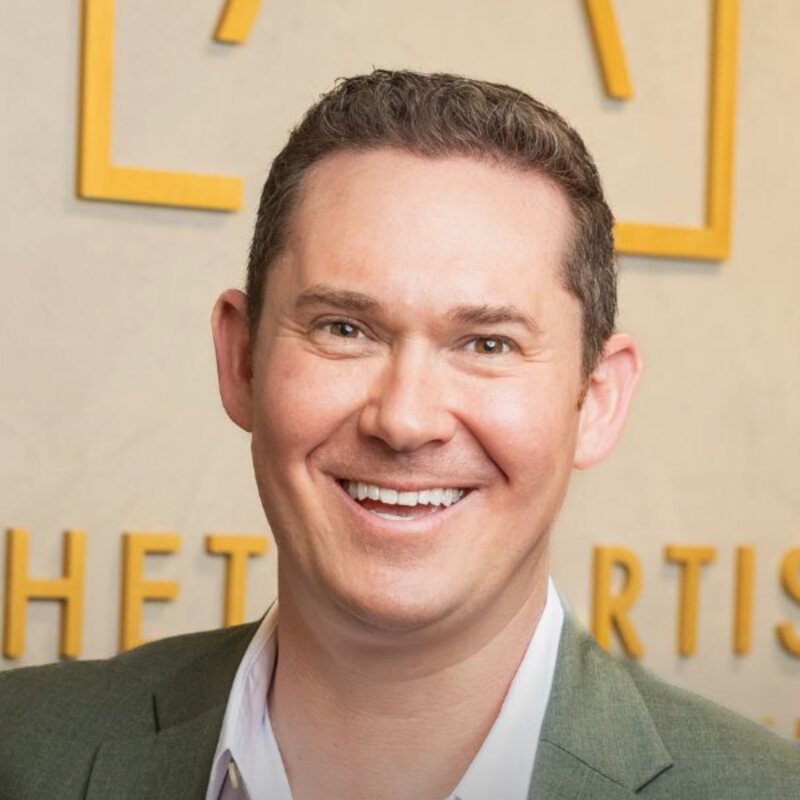
Morgan Gale has spent more than twenty years with a laser or a needle in his hand. A board-certified cosmetic and aesthetic laser specialist and Adult Nurse Practitioner, he founded Aesthetic Artistry Laser Center (AALC), now three locations across the DC area in North Bethesda and Annapolis, Maryland and Arlington, Virginia. He trains other injectors for Allergan and Prollenium. And after two decades, he’s landed on a single conviction about where non-surgical aesthetics is going — and it isn’t a device or an injectable. It’s an approach.
“You want to talk about where aesthetics is going as a non-surgical option? It’s the blended modalities — an injectable regimen and a laser regimen,” he says. “You combine those two things and you get way more comprehensive results than we ever got with one or the other alone. Even when you stacked a bunch of injectables or a bunch of laser treatments, you still can’t do anything close to what you do when you blend the two together.”
Everything Morgan does follows from that one idea: no single treatment rebuilds skin. Results are layered, and they take time — his real plans run “a whole year’s worth of treatments.” The hard part is getting a patient to see all those layers at once. So he doesn’t lead with the science. He leads with a lawn.
The front lawn is the whole plan
Morgan is, by his own description, “a big analogy guy.” When a patient is in his chair, he doesn’t open with filler G-primes and cohesivity and laser wavelength penetration depths. He talks about the yard out front.
“Everybody knows the front lawn. Your face is your your front lawn. If it doesn’t look great, everybody looks at it first and sees anything wrong immediately.” From there the entire treatment plan lays itself out. Watering the lawn is the at-home regimen and a monthly HydraFacial — base level, “because you can’t do any of the other things on a dry lawn.” Weeds are the brown spots, redness, and broken capillaries a laser clears away. Aerating the lawn is fractional resurfacing creating the micro-injuries that rebuild the root structure. Fertilizer is the biostimulator driving new collagen. And filling the low spots — the folds, the volume loss — is where dermal filler comes in.
“The goal is to make them understand that rejuvenation is multi-layered,” he says. “It’s not ‘I do one device or one injectable and it does all the things.’ I have to do some things for volumization, some things for collagen, some things for tone, some things for resurfacing. All of that comes into play when you build a legitimate, globalized treatment plan.”
The rest of Morgan’s philosophy is really just that lawn, layer by layer — and the specific tools he reaches for at each one.
Weeds and aeration: the lasers
The first two layers belong to light. Morgan’s device philosophy mirrors his injectable philosophy — nothing single-note. He speaks fondly of the fractionated platforms that clear the weeds and aerate at once: “your Helix, your Fraxel, your Halo — those blended wavelengths are really, really good at general skin rejuvenation.” The Sciton Halo, he notes, “was always so nice” precisely because it married an ablative and a non-ablative wavelength.
But his current favorite is his Helix CO2 laser — and the story of how he bought it is pure Morgan. “I told the rep for years, I’m not buying a new laser until you bring me something that’s not just a CO2 laser. Then one day he came to me and said, I’ve got a blended CO2 and a 1570 laser that’ll shoot at the same time. I said, sign me up — that’s what I wanted. I’ve never looked back.” His signature “Age Eraser” is that Helix run at four different settings, layered with a hyperdilute Radiesse spiked with biologics for brightening. “If you want to talk about glass skin,” he says, “that’s about as glass skin as it gets.”
Fertilizer: collagen from the inside
Clearing and aerating the skin only sets the stage. The next layer feeds it. “Your biostimulators are your fertilizer. You put Sculptra or hyperdilute Radiesse into the skin and it drives more collagen.” He’s particular about the Radiesse: “I’m a big hyperdilute Radiesse guy. Regular Radiesse is great in jawlines, and hyperdilute Radiesse is basically great everywhere else for me.”
Increasingly, he mixes biologics into that fertilizer for what he calls “bonus collagen production.” “I love the biologics — the exosomes, the PDGF. Those are my adjunct to everything now, because they recruit the fibroblast activity that creates the collagen I’m after.” He points to lines like Plated and Toskani — the latter’s PDRN and growth-factor serums and “a hair cocktail that’s honestly pretty impressive.”
Filling the low spots: injectables
The last layer of the lawn is contour — restoring what time has flattened, and keeping new lines from forming. On neuromodulators, the upkeep that keeps the surface smooth: “Botox and Dysport are my go-tos, and they have been for quite some time.”
On fillers, he’s unapologetically Allergan. “I’m a heavy Allergan guy — I love Juvéderm Voluma, I love Ultra in the lips, I love Vollure.” When it’s pure HA volumizing he’s just as happy reaching for Restylane — and here the blended philosophy comes full circle: “Your HA gel products — your Juvéderms, your Restylanes — you use in the places where there’s just volume loss that laser isn’t going to address.” Each layer covers what the others can’t.
A plan measured in months, not minutes
Put every layer together and you don’t get an appointment — you get a roadmap. Morgan is candid that a real plan is “a whole year’s worth of treatments,” spread across eight to eighteen months, not crammed into two. That timeline is also where he’s most energized about what’s new.
The first is alloClae — allograft adipose, essentially injectable fat, which extends that fill-the-low-spots layer to the body. “My new love. What I can do in the hip dips and the butt is nothing short of a lipo fat transfer, but with basically no downtime — a tiny incision, and the fat settles in and integrates with your own.”
The second is what happens before the plan even begins. “The ability to reach out to a patient, have them scan their own face at home and assess themselves before they even come in — it skips a whole step. They come in with better information.” His frustration with the old way is specific: patients arriving with a photo of Bella Hadid or Sydney Sweeney. “That’s not your face. But if Susie does the AI on her own photo and comes in saying, ‘can we do this, and this, and this’ — yeah, we can.” A patient who can see the whole lawn is a patient ready to commit to tending it.
The one thing he wants patients to know
For all the devices and brands, Morgan’s closing advice comes back to judgment, not gear. “There are a lot of options out there, and that’s not a bad thing,” he says. “You just need to know two things. One: is it a proven technology? Two: who’s doing it. I could be the greatest provider in the history of aesthetics, but without the right tools I can’t do much for you. And I could have every tool and with no experience I could potentially make things worse. The quality of the provider and the quality of what they’re providing have to be combined for a great result to happen.”
Which is, in the end, the same lesson as the lawn: no single thing keeps it green. You tend it — layer by layer, over a season, with the right tools in the right hands.